


























Imagine you come home from school and all you have on your mind is to relax, grab a snack and watch something. Picking up your phone? Don’t worry, you aren’t the only one.
As a streaming audience celebrates the final episode of “Stranger Things,” most students are increasingly choosing short from content over traditional movies, signaling a shift and how the upcoming generation will approach their relationship with new media.
Everyone has a preference for the content they consume, however to dig further we asked around campus to students for their response on how they spend their time with short and long form content. Throughout this polling, the majority of the students were inclined to use short-form content within platforms such as TikTok and Instagram reels as their most used media content. Though the use of other social media platforms are present, we took notice that underclassmen (students 10th grade and below) preferred TikTok for the algorithms selectivity, “I don’t have to make decisions on what I’m watching, curing my indecisiveness” mentioned an Edison sophomore.
However, both experienced the painstaking urge to engage in doom scrolling, “It is not that I prefer it, but it grabs my attention more affectively,” an Edison senior said.
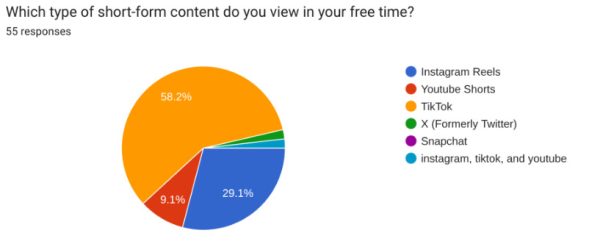
On average, most students spend around 5-7 hours on short-form content per week. Though the outlet for short form content delivered a broad analysis for preference over watching clips of movies, funny moments, and relying on it for quick stories that cover local city-wide news.
Asking the Edison community for their preference on long form content, they found more satisfaction and rebellion against short-form content. Various students expressed their dislike for the difference in depth between the two content mediums, “TikTok sometimes provides content that I don’t like and some content that just repeats,” mentioned an Edison junior.
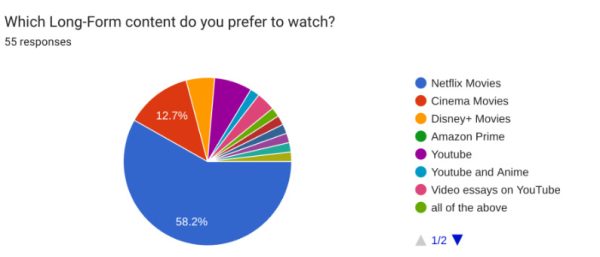
The majority of students choosing to watch long-form content dominated the Netflix platform, as over half of our polls have responded to using Netflix, YouTube content acting as a runner-up. The average watch time was 3-4 hours per week for long form content for Edison students. Provided that these hours are shorter, most students prefer this content to get lost in the character and story development for movies and shows, while also practicing to prevent their habit of consuming short form content in their free time.
Although we felt that our polls delivered a stance at how Edison students felt impacted by these different forms of mediums, we asked students to elaborate more on how this preference of content has taken shape.
Tanisha Ahmed, a senior, shared that she mainly uses TikTok because of its short and fast-paced format.
“I mostly use TikTok because I like how the videos are short, unlike YouTube videos,” Tanisha said. She explained that short-form content feels easier to consume during busy school days, adding that, “the videos are short and it’s easy to watch — for movies, it’s time consuming.” Her response reflects a common student preference for quick entertainment that fits into short breaks and downtime.
Sirajim Munira, a sophomore, said TikTok is her top choice because of how customizable and social the platform feels.
“Mine is TikTok because I can spend time searching for exactly what I want to watch. I can spend time making and watching niche videos in a short amount of time and engaging with friends humorously,” Sirajim explained. Her response highlights how short-form content allows students to personalize their experience while staying connected with others.
As for our faculty, we were able to meet with various teachers who sympathized with the struggle from short-form media time, leading them to spend less time to watch long-form media.
“It’s like not getting all the puzzle pieces. The bigger picture just isn’t there. Short-form content can be entertaining, but it’s not always as informative,” Mr. Veyvoda said.
Though the approach towards short form content stands entertaining, Mr. Anderson, Edison’s AP world teacher, describes the impact of short form content being therapeutic after spending a long time in school, “I watched short clips of the HBO series Chernobyl for years before finally having time to watch the full show—and it was phenomenal.” Though the time that short form content is being spent on takes away time for them to spend working on their other passtimes, “I could be spending that time doing other things. I’ve been trying to intentionally put my phone down and read a few pages of a book instead,” Mr. Anderson said.
Overall, faculty perspectives highlight a balance between the convenience of short-form media and the value of deeper engagement with both forms of content in our everyday lives.
From the information gathered, short-form content has had a significant hold on both youth and adult minds, with students stating their love of scrolling on TikTok or Instagram whenever boredom comes through the door, a quick way to boost dopamine levels without too much time or focus. However, that doesn’t mean that long-form content like movies or TV shows isn’t completely replaced, as it still holds a strong place in the hearts of all ages. Both types of content can be addicting and entertaining at the same time, but it’s important that we balance both interests in a healthy way.