

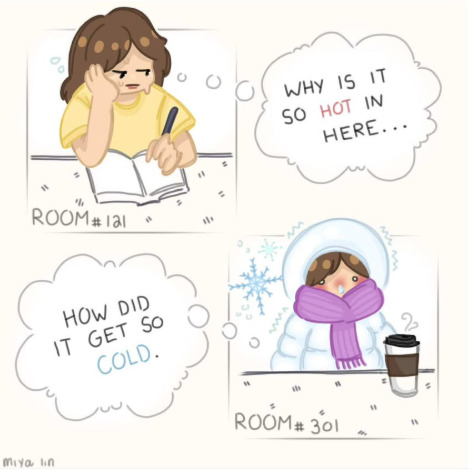
Classroom temperatures at Thomas A. Edison CTE High School often fluctuate throughout the day, creating uncomfortable learning conditions for both students and teachers. While some rooms feel freezing cold, others become excessively warm, making it difficult for students to stay focused.
Many students say these conditions interfere with their ability to learn.
“The building is pretty old, but it should still be a priority for teachers and staff members to make sure students are comfortable,” said Senior Raisa Afrin. Seasonal changes make the issue more difficult to manage, especially during colder months when heating systems do not always function properly.
Winter temperatures seem to be the most disruptive.
“It’s worse in the winter than in the summer because it gets really cold when the heat isn’t working properly,” said Senior Elizabeth Guillen. Students also report that temperature problems vary depending on where they are in the building.
For some students, these temperature differences directly affect their performance in class.
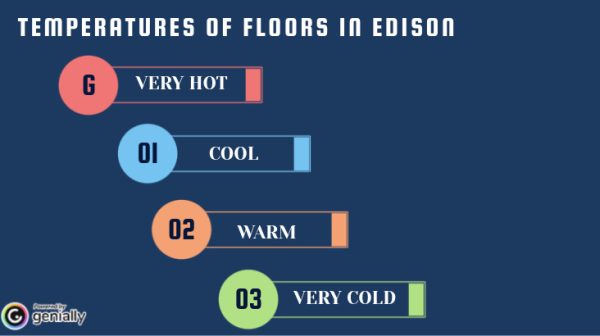
“My shop class on the first floor is really cold. When it’s cold, I fall asleep a lot and can’t really focus on what I need to do,” said Junior Darron Budhram. He added that the temperature shifts from floor to floor, explaining, “The ground floor is really hot, the first floor is cold, the second floor is hot, and the third floor is cold.”
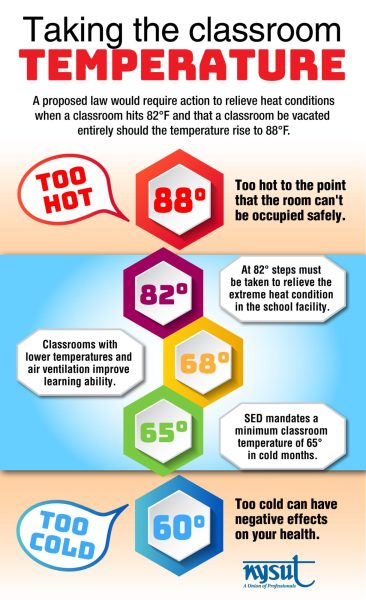
These experiences align with research showing that classroom temperature plays a significant role in student performance. Studies indicate that students perform best in classrooms kept at moderate temperatures, around 72 degrees Fahrenheit. When classrooms become too warm, students are more likely to feel fatigued, lose focus, and perform worse on reading and math tasks. On the other hand, classrooms that are too cold distract students with physical discomfort, increasing error rates and reducing concentration (Lawrence Berkeley National Laboratory).
While some students struggle with cold classrooms, others experience the opposite problem. Teachers often open windows to cool overheated rooms, which can cause sudden drops in temperature.
“I usually sit near the windows, so the gusts of wind are always blowing in my face,” said Senior Raisa Afrin.
Teachers have also noticed the impact extreme temperatures have on students.
“Because of the extreme heat, students are constantly falling asleep. Then when we open the windows, it becomes freezing cold, and they start putting on coats and hoodies,” said Ms. Dellabonta, History Teacher.
To better understand how temperatures are regulated, the school’s head custodian, Mr. Passaggio was interviewed. He and his team are responsible for managing heating and cooling throughout the building. It is important to consider that they are mandated to follow the NYC Department of Education’s Temperature Regulations.
When asked about the thermostats in the classroom, Mr. Passaggio said, “Teachers all have access to control the temperature in their classroom through their thermostats.” However, some teachers have said their thermostats are locked and require assistance to adjust and some admitted not knowing who to ask.
Several teachers reported being unaware that thermostats existed in their classrooms.
“No, I don’t know where the thermostat is. I don’t remember being told that I could request a change in the temperature either,” said Mr. Koos, Graphic Design Teacher. After locating it, he added, “Well, it doesn’t seem that accessible, since it’s locked.”
Others shared similar experiences. “I didn’t even know a thermostat existed in all rooms,” said Ms. Dellabonta. “Ms. Rosario, College Office Staff, also said she had just discovered there was a thermostat in her office,” also said Ms. Dellabonta. She explained that staff have turned off lights, opened windows, and contacted administrators when they noticed problems, such as a burning smell coming from the heaters.
This confusion has contributed to ongoing miscommunication. Many teachers reported their concerns to assistant principals, not realizing that custodial staff were the appropriate people to contact. According to Mr. Passaggio, no temperature-related complaints have been directly reported to his team.
As a result, classroom temperatures at Edison remain unpredictable, affecting students’ focus and teachers’ ability to maintain a productive learning environment. Until communication improves between staff and custodial teams, these issues are likely to continue.
“If students aren’t comfortable, how can you expect them to learn the content?” said Senior Raisa Afrin.