
At Thomas A. Edison Career and Technical Education High School, students in the electrical shop spend their days working on hands-on projects that prepare them for real-world careers. However some students in this program feel as if it doesn’t always get the same attention for their work as other shop classes.
In the lower grades, students are introduced to foundational skills. In Mr. Delacuesta’s low voltage wiring class, sophomore Jonathan Persaud described working directly with wires as one of his favorite parts. “We get to cut wires, strip the wires, and connect them,” Jonathan said. Delacuesta explained that 10th-grade students begin with low voltage wiring circuits and later transition into working with non-metallic cable circuits, which are similar to residential wiring used in homes.
The program is also designed to prepare students for real-world careers.
“They do a 10-hour OSHA, which in construction, when you’re in the union, when you work for an electrical company, they have to have a 30-hour OSHA. And at the end of the year, they’re also going to be doing the non-metallic cable, so that’s similar to the wiring that you do in a house,” Delacuesta said. In addition, the program offers internship opportunities with organizations such as Solar One and the MTA, giving students exposure to the industry.
The electrical shop teaches a wide range of practical skills, including wiring circuits, working with different types of cables, and understanding how electrical systems function in everyday life. Persaud emphasized how relevant these skills are.
“It’s everyday things that we need, like lights and how systems are set up,” Jonathan said.
In the upper grades, students move on to more advanced work.
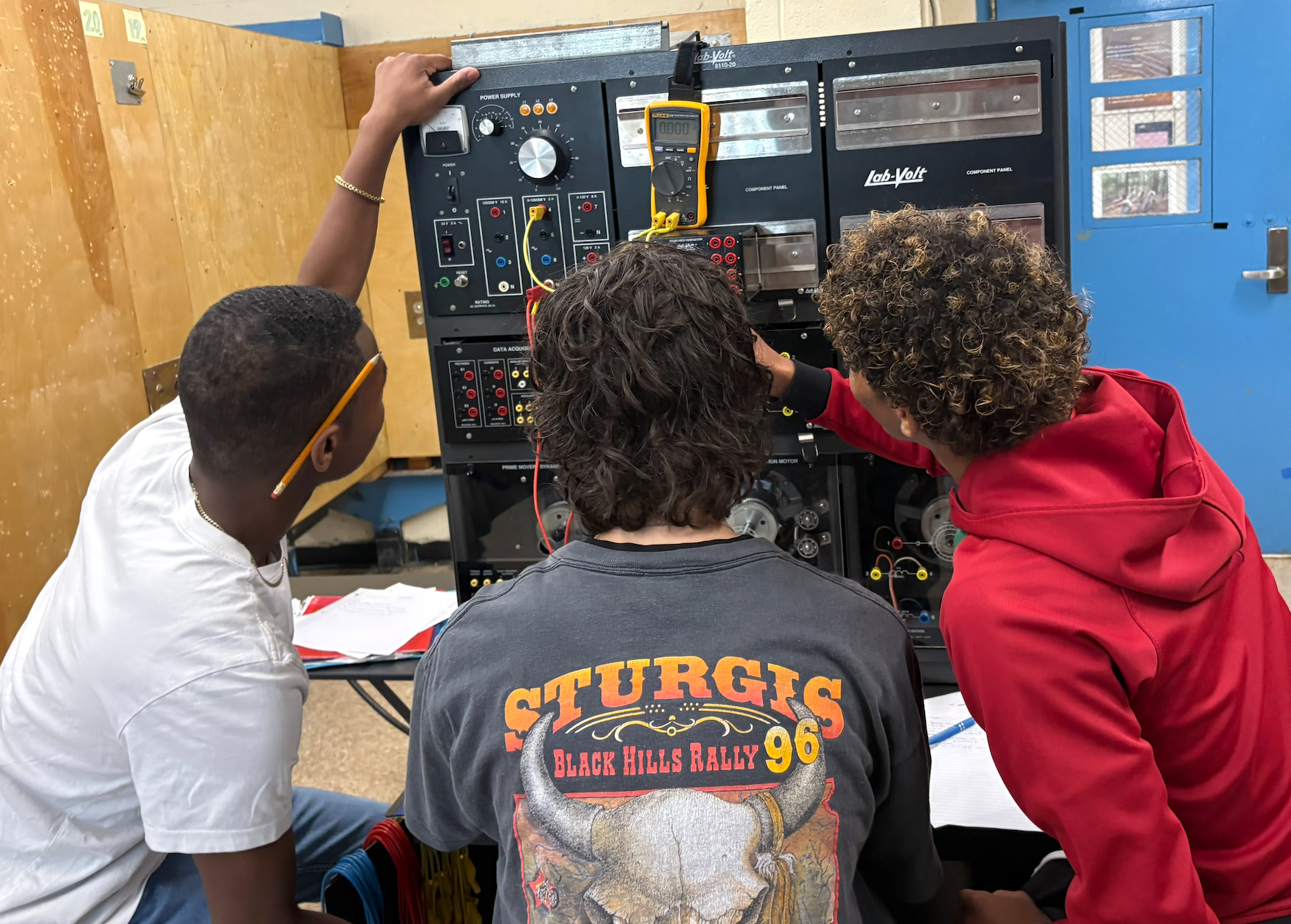
“They complete residential wiring projects in 11th grade, so it’s like house wiring, with arm and cable. They connect three-way switches, four-way switches, to control lights from multiple locations. Then they work with conduit, electrical metallic tubing. They also learn how to bend the electrical metallic tubing. They perform calculations. They use some basic trigonometry and algebra. They make calculations for circuits using Ohm’s Law. In the senior year, they also bend pipes. They learn more sophisticated banks, three-point saddles, four-point saddles. And now, students are working with lab-built equipment,” electrical teacher, Anthony Thomas Cooper said.
A typical day in the senior class, they follow a structured routine. According to senior Christopher Solis, students begin class by taking out their notebooks and listening to a short briefing from their teacher before getting to work.
“Mr. Cooper gives a small briefing and says ‘go to work,’ and we continue to work for the rest of the time,” Christopher said.
The class ends with cleanup, where students organize their materials before leaving. Students are currently doing hands-on projects as well preparing for their certifications. Solis said his class is studying for a 174-question electrical certification exam based on material learned over the past three years. These certifications can help students enter the workforce immediately after graduation.
Mr. Cooper also shared how the program has grown over time. When he first arrived at the school, the electrical shop was struggling and at risk of shutting down because they could not find a qualified teacher. With support from Principle Ojeda, Cooper helped rebuild the program from the ground up. He was given funding to renovate the space, purchased new materials, and even brought equipment from his previous school to improve student learning. “If you didn’t come here, this shop was going to disappear,” he recalled being told. Since then, the shop has expanded and continues to develop.
Despite the valuable experience students gain, both students interviewed agreed that the electrical shop does not receive as much recognition as other programs.
“People only talk about IT and automotive,” Persaud said. Solis shared a similar view, explaining that he originally wanted a different shop before realizing how useful electrical skills could be.
Mr. Cooper also believes that awareness is an issue. While the school supports the program, not all students fully know about it.
“There are kids that pop their heads into this room,” Mr. Cooper said, suggesting that more exposure could help students better understand what the shop offers.
Delacuesta added that what makes the shop unique is its importance to everyday life. “Without us, really, no other shop would work because you need electrical for everything,” he said.
Overall, the electrical shop provides students with valuable hands-on experience, real-world skills, and career opportunities. From learning basic wiring to mastering advanced electrical systems and gaining internship experience, students are well-prepared for future careers. However, many believe the program deserves more recognition within the school community.