
This year at Edison, mock Regents exams changed how midterm season looked for both students and teachers. Instead of a regular schedule in March, the school day was reshaped around district-required testing. While the goal is to better prepare students for state exams, however, the changes have shown mixed reactions across the school community.
In previous years, midterms were typically held in January, while final exams were scheduled closer to May, when most courses had finished covering material for state tests or AP exams. This March, however, looked different, as new district-required mock Regents exams were introduced across subjects. The purpose of the mock Regents is to give both students and teachers a clearer understanding of student progress.
“The mock Regents are designed to give both students and teachers a clearer picture of how students are performing in relation to Regents expectations at this point in the year,” Assistant Principal of Instruction Ms. Tamayo said. She added that the results help teachers identify strengths and areas where students still need support so instruction can be adjusted before the actual exams. While she noted that the process continues to be refined, she emphasized that the goal is to better prepare students for state testing through data and feedback.
The idea of mock Regents had been mentioned as early as January, but details were still unclear for much of the planning process.
“It wasn’t until early March that I started to find out more about this mock exam and the scheduling,” said social studies teacher Ms. Petroutsos, noting that initial announcements were brief and not fully developed.
Ms. Petroutsos described the process as developing over time rather than a fully established plan from the beginning. While she was informed through department discussions and committee meetings, there was still uncertainty about how the exams would be structured. When asked about the purpose of the mock Regents, Ms. Petroutsos focused less on scheduling and more on how the exam affected students.
“Emotionally, it would shatter a student who either is a student that struggles on assessments or even a student that does really well, and now all of a sudden they’re met with questions they don’t know,” Ms. Petroutsos said. She added that while the goal is to gather data on student performance, unfamiliar material may not always reflect student understanding.
Along with these changes, the school also followed a modified schedule from March 13 to March 18. During this period, the school day began at 11:18 a.m. for students not taking exams, and most class periods were shortened to about 15 minutes. Two full-length periods were still held each day, rotating throughout the week so that different class blocks met on different days.
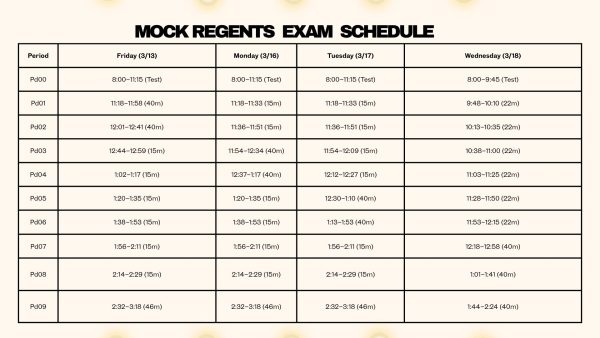
Assistant Principal Dr. Collado, who helped organize the logistics of the testing week, explained that the schedule was designed with both testing and instruction in mind.
“The primary concern was how to be equitable in the distribution of minutes for the remainder of the day,” Dr. Collado said, noting that the goal was to keep the school day as close to normal as possible while still accommodating exams. He added that planning also involved coordinating classrooms and proctors based on the number of students taking each exam.
These adjustments were part of the overall organization of the testing week and affected how instructional time was distributed across subjects, particularly in courses that rely on consistent pacing. For AP classes, teachers noted that maintaining course progress became more difficult during this period.
“Even though we had students come in for two hours one day, we still lost a few days of instruction,” said Ms. Ambrosini.
AP Chemistry teacher Ms. Ambrosini explained that her class made adjustments by bringing students in earlier for additional instruction to keep up with the curriculum. While this helped to some extent, she said it did not fully make up for the lost time. She also noted that not all students were able to attend these sessions, which affected consistency in staying on track.
In the end, administrators emphasized that the goal of the mock Regents was to give students a more realistic testing experience.
“We’re trying to give students as close to a real scenario as possible before the exams in June,” Dr. Collado said.