


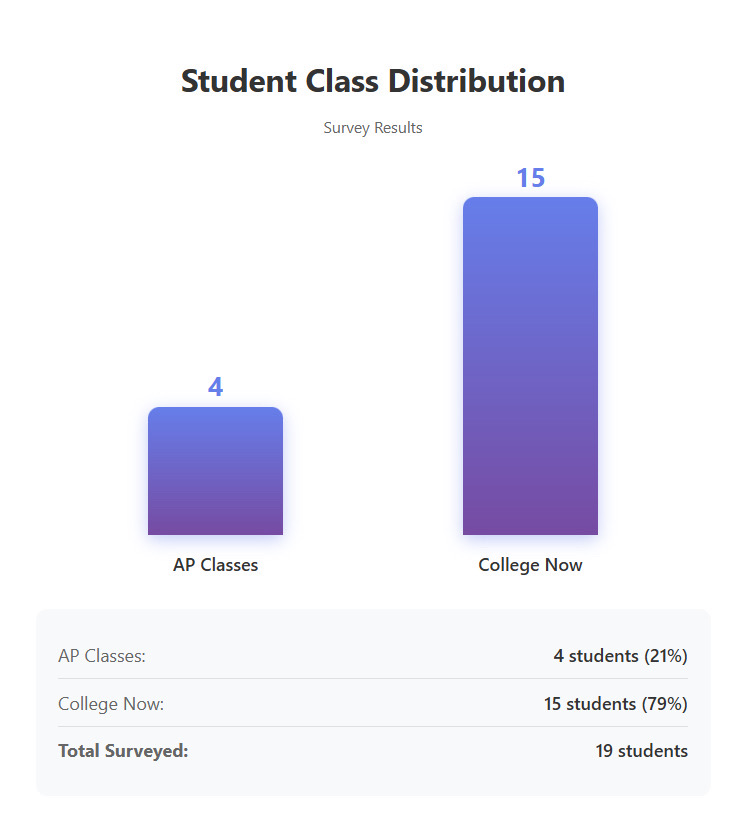
Every spring, the same dilemma hits: sign up for AP classes and gamble everything on a single three-hour exam in May, or take College Now and actually sit in real college courses while still juggling high school hallway drama. It’s like choosing between a high-stakes poker game and a guaranteed coupon, except nobody’s quite sure which one actually pays off, and the dealer keeps changing the rules.
The debate isn’t just about which program is “better.” It’s about which one actually delivers on its promises. AP offers the prestige and GPA boost, but requires passing a high-pressure exam that can feel like your entire future depends on filling in the right bubbles. College Now guarantees the credit, but demands after-school time and doesn’t always transfer beyond CUNY schools. The stakes are real: choose right and save thousands of dollars, choose wrong and waste a year of hard work for credits that vanish into thin air.
The Workload Reality Check
Saleh Khatari, an 11th grader who’s survived both programs, explained that AP classes are more challenging compared to college courses because “AP classes need to cover more resources in such a short amount of time.”
Khatari noted that the workload differs significantly. In college classes, completing assignments during the two-hour class period was often enough. In AP classes, students were expected to juggle homework, classwork, and study for quizzes or tests, basically a full-time job without the paycheck. Despite the challenges, Khatari earned college credit from both programs. “I earned many college credits from the College Now classes as well as from my AP class since I got a 4,” he said.
Nuria Hoque, also in 11th grade, chose to take both AP and College Now classes to challenge herself and prepare for college. She found AP classes more difficult because “the teachers teach at a more faster pace and sometimes I don’t absorb the information as I should.” While she described both programs as content-heavy with similar workloads, she said College Now felt more like the real college experience, and not always in a good way.
“The professor gave out many quizzes and it was a ‘you get what you get’ situation,” Hoque explained. “There weren’t many chances to get extra credit or other assignments to improve grades unlike AP courses.”
College Now professors grade like actual college professors: no mercy, no grade inflation, no second chances to fix that quiz you bombed because you stayed up too late watching Netflix.
Despite finding both options stressful, largely due to her own procrastination habits, Hoque prefers College Now because it guarantees college credit. She pointed out that AP credits depend on both the college you attend and your exam score, which can make the outcome feel like spinning a roulette wheel with your academic future.
The Transfer Problem Nobody Warns You About
Here’s where things get complicated, and why reading the fine print actually matters for once.
Priti Narain, a graduate now attending Hofstra University, took both AP and College Now classes in high school and learned an expensive lesson about credit transfers. While she earned college credit from both programs, her College Now credits didn’t transfer to Hofstra even though she passed with straight A’s. Those hours of work? Gone. Vanished. As useful as a gym membership in January by the time February rolls around.
“I’m so grateful I took them because I’m on track to graduate a semester to a year early from college,” Narain said, but she was talking about her AP credits, not College Now. Her experience highlights a crucial difference between the programs: College Now benefits CUNY-bound students most, while AP classes transfer more reliably to SUNY and private universities.
If she could choose again, Narain would pick AP classes because “they fit into our regular schedule in high school” and added a GPA boost that recognized her higher-level work. For students who aren’t planning to attend a CUNY school, those College Now credits might be about as useful as a homework pass on the last day of senior year.
So Which One Should You Pick?
For students planning their college path, the choice between AP and College Now comes down to a few key factors: where you plan to attend college, how you handle test pressure, and whether you prefer guaranteed credit (that might not actually be guaranteed everywhere) or the potential for a GPA boost.
If you’re heading to a CUNY school, College Now is probably your best bet. The credits will transfer, you’ll get real college experience, and you won’t have to bet everything on a single exam score. If you’re aiming for a private university or SUNY school, AP classes are the safer choice, even if that means cramming for an exam that determines whether an entire year of work actually counts for anything.
As Narain put it simply: know where you’re going before deciding which program to take. It’s advice that sounds obvious but could save you from discovering too late that your hard-earned credits have an expiration date.
The decision deadline for next year’s classes is approaching fast. Students have two different paths to college credit, and choosing the right one could mean the difference between graduating early with money in your pocket and starting college from square one, wondering where all those credits went.